Prepared by the ISTM Mass Gathering Interest Group
Background
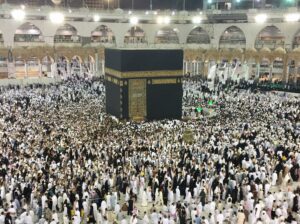
The Hajj and Umrah, the pilgrimages to Saudi Arabia, has been associated with outbreaks of meningococcal disease. Pilgrims arrive from more than 180 countries, potentially acquiring pathogens in Saudi Arabia, and return to their native countries, potentially transmitting acquired pathogens back home.1 Strict enforcement of mandatory vaccination with the quadrivalent Men ACWY vaccine since 2002 against Neisseria meningitidis, the bacterium causing meningococcal disease, has led to the absence of outbreaks for more than 17 years.
Changes since 2019
Saudi Arabia introduced new visa types in 2019 to broaden its tourist base to beyond religious travels. The implications were initially dwarfed by the COVID-19 pandemic which severely restricted global travel. These tourist visa types had some ‘advantages.’ Firstly, it had no restrictions and did not prohibit the performance of Umrah. Secondly, they were cheaper than an Umrah visa. Thirdly, they did not require proof of Men ACWY meningococcal vaccination which was still mandatory for an Umrah visa. This led to a marked decline in Men ACWY vaccine uptake amongst Umrah pilgrims.2
Umrah in Ramadan: The Numbers
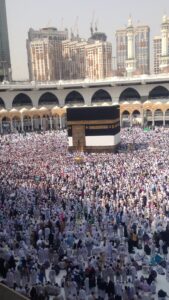
The Islamic holy month of Ramadan will be from about 17 February-18 March in 2026, which is in the Saudi winter and early spring when respiratory infections are common. During Ramadan in 2025, more than 90 million prayed at the Holy Mosque in Mecca, with about 16 million performing the Umrah pilgrimage.4 The Prophet’s Mosque in Madina was visited by 30 million worshippers. Similar numbers are expected for 2026. The number of travellers arriving from outside Saudi Arabia is not known.
Outbreak Associated With Ramadan 2024
By May 2024, twelve cases had been reported, from France (4), the United Kingdom (3), and the United States (5). Ten cases reported performing the Umrah pilgrimage while in the KSA and showed signs upon their return, whilst 2 were in unvaccinated children who did not travel but who were in contact with a returned unvaccinated and asymptomatic pilgrim. Studies proved that the involved serogroup W was linked to the circulating Saudi one.5 Other countries were also affected, including Uzbekistan where the incidence of meningococcal disease was 10 times higher in 2024 compared to 2023.6 Most cases were either in unvaccinated returning Umrah pilgrims or in those in close contact with them.
Outbreak Associated with Ramadan 2025
During Ramadan 2025, confirmed meningococcal cases were reported among unvaccinated international Umrah pilgrims in Saudi Arabia, with serogroup W identified in sequenced samples. Cases were soon documented in returning pilgrims or their close contacts. Italy reported 4 cases, with the UK, Qatar and Dubai being of some of the other countries that were also affected. Of concern was the death of a 2-year-old previously healthy girl in India whose grandparents returned from Umrah 10 days previously. They were vaccinated, but with the polysaccharide vaccine which is known not to eliminate nasopharyngeal carriage. The serogroup was confirmed to be serogroup W.4
Current Advice
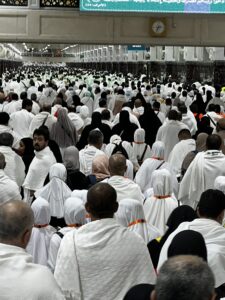
Umrah in Ramadan is associated with crowd densities of up to 8 pilgrims per square meter and with a very high incidence of respiratory infections. Both these factors may promote the spread of meningococcal disease. The medical fraternity is again reminded of the WHO’s ‘Defeating meningitis by 2030 global road map.’ One component of this is the promotion of effective and proven vaccines. The Men ACWY conjugate vaccine, which is valid for 5 years, is one of them and all travellers intending to perform Umrah must be encouraged to take it. This vaccine protects the pilgrim and eliminates nasopharyngeal carriage and thus prevents spread. In some countries only the polysaccharide vaccine is available. This protects the pilgrim but does not eliminate nasopharyngeal carriage and is valid for 3 years.
A repeat of the 2024 and 2025 Umrah associated outbreaks and the spread beyond Saudi Arabia is preventable by the administration of the appropriate conjugate Men ACWY vaccine.
- Parker S, Almayahi ZK. Saudi Arabia: Hajj and Umrah Pilgrimages. CDC Yellow Book: Health Information for International Travel (2026). https://www.cdc.gov/yellow-book/hcp/africa-middle-east/saudi-arabia-hajj-and-umrah-pilgrimages.html ↩︎
- Alshahrani NZ, Rashid H, Parker S, Asiri AM, Memish ZA. Lancet Microbe Correspondence: Pilgrimage and Prevention: Closing Meningococcal Gaps Ahead of Hajj 2025. Mass Gathering Medicine. 2025 Jun 9:100019. ↩︎
- Over 122 million visited the Two Holy Mosques during Ramadan. https://saudigazette.com.sa/article/650540 ↩︎
- Al-Tawfiq, JA, Memish, ZA. The Return of MenW: Religious Mass Gatherings as Global Catalysts for Meningococcal Spread. J Epidemiol Glob Health (2025). 15, 115. https://doi.org/10.1007/s44197-025-00463-1 ↩︎
- Uzbekistan makes meningitis vaccination mandatory for hajj pilgrims amid rising health concerns. https://www.gavi.org/vaccineswork/uzbekistan-makes-meningitis-vaccination-mandatory-hajj-pilgrims-amid-rising-health ↩︎